LW Mag LW Magazine

Related Articles



J-Bay local, Craig Jarvis, ventured to Hawaii in December to cover two huge surfing events namely the Billabong Pipeline Masters and the Red Bull Jaws Paddle at Peahi. One event made history and one hasn’t happened yet. Here is his story:
I’m in Hawaii for the Billabong Pipeline Masters, the most prestigious event on the World Tour. I’m also in the Hawaiian Islands for coverage of the Red Bull Jaws Paddle at Peahi event, set to take place on Maui. My window for both events is December 8 – 20, 2013. In that brief period I witnessed the Pipeline Masters and the crowning of Joel Parkinson as the Surfing World Champion, but not the Red Bull Jaws event. The waves didn’t get to minimum size, and with plenty of time in the waiting period, the event wasn’t called. Twiggy and the rest of the invitees were standing by, but it was not to be. The waiting period runs till the end of March, so by the time you read this it might have run.
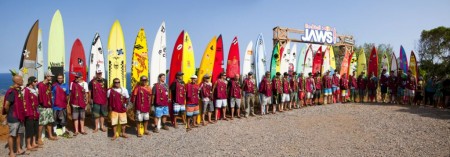 Photo Caption: Competitors take place at the opening ceremony for the Red Bull JAWS paddle in surf event at JAWS. Photo: Zak Noyle/Red Bull Content Pool
The water’s warm and inviting. After about 40 hours of non-stop travelling, we’re straight out there. Just Off The Jet. It’s just board shorts, and step-up board. Waves look small, so no need for the gun. My Hawaiian mate leads the way, and I’m in the channel and stroking seaward on the 6’5.
It doesn’t take long for me to realize that it’s just a little bit bigger than I thought. Maybe I could have gone the 7’2, but I’m still feeling all right with the 6’5 under my chest. Plenty of foam and plenty of width; pulled in tail, big fins. I’ll be ok.
There’s a bit of a lull, so we paddle into the vast take-off spot amongst a crew of locals and visitors. Everyone seems on high alert. We slip in, sitting on the deep edge of the pack, close to the channel, taking it easy.
There’s a sudden panicky movement, and the entire pack starts paddling like crazy. I haven’t seen anything, so I just paddle along, out and wide. It must be a set, and it must be pretty solid to instigate this sort of response.
We crest the first wave and see it – a long black wall of water that is going to break on top of us no matter what we do and where we paddle. As fast as that, I’m in the zone, I’m right in the middle of Hawaiian energy, and facing fears, demons and perspective all at once. The older Hawaiian guy slips off his board and starts swimming down. I jump off my board and swim as deep as I can. The warm water doesn’t let me too deep, until I turn around and kick hard for the bottom.
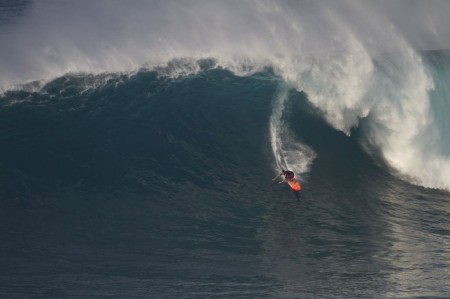 Photo Caption: Jamie O’Brien surfs pipeline on the North Shore. Photo: Brian Bielmann/Red Bull Content Pool
The sound of the wave breaking, smashing the surface tension and sending plumes of directed whitewater deep down is a terrifying roar. I wait for the impact, for the tumult of incredible ocean power to pick me up and throw me around a bit, to wake me up, to remind me that I’m no longer surfing a mellow Eastern Cape beach break. It doesn’t hit, it leaves me alone and I surface clear of the impact zone, unscathed. I take a deep breath, pull my board in and paddle well into the channel. My nerves are jangling and my adrenal glands are squirting. It’s time to reassess. I’m in Hawaii. It’s not an exotic boat trip with soft waves or a holiday in paradise. Hawaii is the real deal.
Every surfer, surf magazine editor in the world, every surf photographer, every journalist and every videographer should come to Hawaii for the winter contest season. It’s the meshing of our sport and culture, the culmination of a year’s worth of competition and the best big waves in the world. Big wave surfers and free surfers rub shoulders with WQS heroes and world champions. Hawaii does not differentiate, does not care who you are or what your credentials are. Some of the best big wave surfers in the world have died in Hawaii; killed by the ferocious waves. The shorebreak is the only bouncer. Get past the shorebreak and you’re in the party, same as the rest of us.
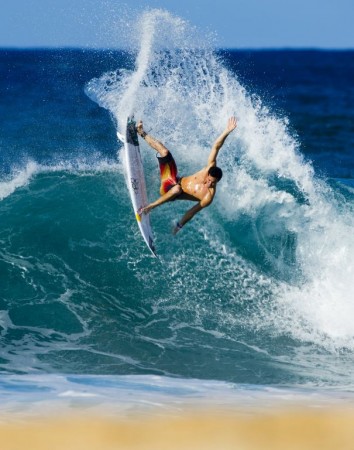 Photo Caption: Jordy Smith in action in Hawaii. Photo: Kolesky/Nikon/Red Bull Content Pool
The North Shore Winter of 2012/2013 was no different to others, with Pipeline producing the goods for 3 incredible days of surfing, with 8-foot Hawaiian-size waves pouring and slabbing over the most famous piece of reef in the world. The South African professional surfers in the event were Jordy Smith and Travis Logie, both from Durban. Neither fared too well in the event, but both requalified for the 2013 World Championship Tour with good performances throughout the year. Travis is the seasoned campaigner; while Jordy, who was the runner up to the world champion in 2010, is the young gun set to blow the surfing world apart. An injury in 2011 put him out for the later part of the season, and a bit of bad luck dogged him in 2012, but all looks set for a ripping 2013 campaign.
Another top professional surfer from South Africa, Grant ‘Twiggy’ Baker was also present and accounted for in Hawaii. Twiggy is South Africa’s star big wave surfer, and he was invited to two big wave events in Hawaii, the Red Bull Jaws event and the Quiksilver Eddie Aikau invitational. Both invites were a massive honour, and along with the invite into the Mavericks Big Wave event in California, Twiggy was the only South African representing at all three big wave events. At the time of press, none of the big wave events had been given the green light, with few giant swells lighting up the buoy readings for the big wave spots to come to life.
While the Mavericks and Eddie events have been around for a while, the newest member of the big wave contest scene – Jaws – promised one helluva spectacle. With Jaws usually involved in the Billabong XXL Awards for the biggest wave of the year or the ride of the year, it is known to produce wave faces of above 60-foot. This type of surf was primarily the realm of tow surfing alone, but over the last few swells Jaws has become a paddle only spot, with big wave surfers now determined to catch the biggest rideable waves in the world by muscle power as opposed to PWC horsepower.
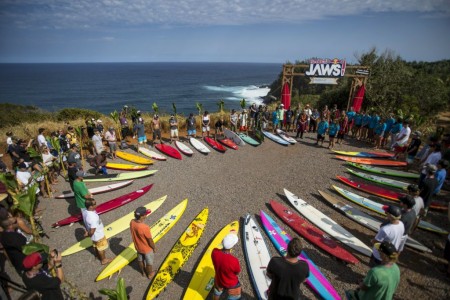 Photo Caption: Competitors take part in the opening ceremony for the Red Bull JAWS paddle in surf event at JAWS. Photo: Robert Snow/Red Bull Content Pool
There are a few things to consider when going to Hawaii, especially for the first time. All the horror stories and big wave drama is but one facet of what goes down on the North Shore. One of the most important things to remember is that it’s not always massive. There are so many days of 4-foot perfection, gently groomed by offshore winds, with all the waves along the seven miles stretch coming to life. For those of us who are not wont to paddle out into giant Waimea or macking Pipe, there is still plenty of surfing to be done; you just need to know where to go. There are inside waves and there are soft waves. There are secret spots and there are outside reefs. There are places that are tucked away when the swell gets massive, and there are three other shores apart from the North Shore – it is an island after all.
If you’re going to give it a go when the going get serious, then the best bit of advice is to get a big wave board from Hawaii. The local board makers understand the waves, how powerful they are, and what sort of boards work best under such big and strong conditions. Instead of lugging a 10-foot surfboard halfway around the world and paying excess for it all the way (USA airlines are ruthless with charging for surfboards) rather buy a board on the North Shore. A good second-hand board made on the island for island waves will do you much better than a big wave board made anywhere else.
Localism is a serious problem at most waves on the North Shore, but if you’re not out to hassle Sunny Garcia or snake Garret MacNamara then you’ll be fine. You wont catch as many waves as back home, but you shouldn’t lose any teeth if you play it cool, and show some respect.
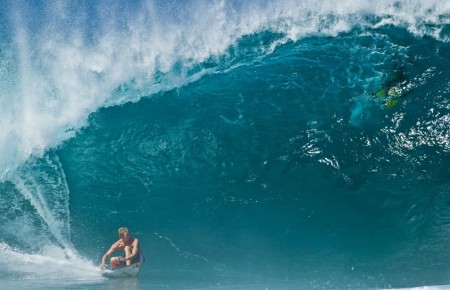 Photo Caption: Jamie O’Brien surfs pipeline at North Shore. Photo: Brian Bielmann/Red Bull Content Pool
There are quite a few accommodation options, with the Ke Iki Bungalows the place to be at affordable rates. You’ll need to do a bit of online digging to find the gems. Top end digs are to be found at the Turtle Bay Hotel, where you can hang out with rock stars, film starts and world champion surfers. Costs you US8$ for a coffee though – you do the math.
Things move really slowly on the North Shore, and when I say things I mean cars. Once you’re off the Kam Highway and cruising around residential streets, speed limit is about 5 kays per hour, as the local kids are often running free and chasing balls from their drives onto the road and stuff like that. Go any faster, and you’re going to get a large Hawaiian man come bursting out of his house, chase you, and smack you in the face regardless of whether your window is up or down. In Hawaii you have to ‘roll slow’ and it’s a good motto to have for your whole Hawaiian experience.
The most beguiling thing about the North Shore of Oahu, Hawaii and the thing that keeps people coming back, year after year, is the simple fact that on any given day you might just catch the best wave of your entire life. You might experience the thrill, rush and fear of a moving mountain and survive to tell your story. Hawaii is part of the surfing addiction.
 Photo Caption: Carlos Munoz surfs in North Shore. Photo: Agustin Munoz/Red Bull Content Pool
Words by Jarvi